Today in West Civ, we watched a few videos. The first one we
watched was a video to persuade you to come to Baltimore. The video was pretty
awful and it was not appealing at all. Then we watched on that had to do with
LA. It was amazing. It makes me really want to go there. This lead up to a
project we are going to do. We have to make a commercial about Athens and
Sparta. I think it is kind of confusing but it sounds kind of fun.
Friday, February 28, 2014

Wednesday, February 26, 2014
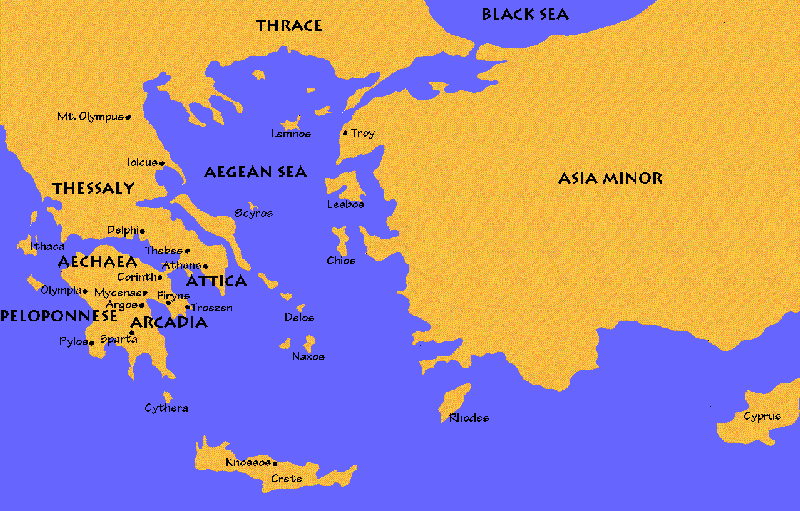
Today in Western Civ, we had another student teach us about the Greeks. It was actually the same person it was on Monday. But anyway basically in our discussion we talked about Athens and Sparta, and about how there different. Spartans had a strong army on land and Athens had a navy. Also we talked about the different governments. Some include; Monarchy, oligarchy, tyranny, and democracy. Then we went over the Greek Map and were told to basically know were things were so I put in a map of Greece.
Tuesday, February 25, 2014
Today in Western Civ, we took notes on the Greek
civilization. The best part of class to me was the last 20 minutes. We talked
about the Odyssey and Iliad. Mr. Schick was telling us stories that are in the
book. I don’t really understand something though. Is the Iliad in the Odyssey
or are they two different books. I don’t really know, but the stories that we
were getting told were really interesting. Like the main guy, I forget his
name, and how he was at war for ten years, and then he was stuck at sea for ten
days. It was very interesting.
Monday, February 24, 2014
Today in Western Civ, we didn’t have Mr. Schick to teach us.
Basically all we did was look over the book and take notes on it. Then one of
the students came up and taught the class, and asked us questions. I think the
person who did it, did a pretty good job! Basically this assignment took all of
class to do. Other than that we didn’t do anything else.
LO3 Notes
Citizens and Communities: The Greek City-States
-Greek- city states were small places, generally consisting of no more than a town and a few square miles of surrounding country-side
-Athens, and Sparta were the same size as couple of U.S. counties, were giants among city-states
-Acropolis- a combination of fortress and temple precinct
-fortresses and temples were vitally important to the Greek city- states
- the Parthenon, or "place of maiden" overlooked the whole city
-the Greek language is the first that is known to have had a specific word for a member of such community; "citizen"
-the notation of citizenship seems to have originated partly in geography
-hoplites- a heavily armed and armored citizen- soldier of ancient Greece
-phalanx- a unit of several hundred hoplites, who closed ranks by joining shields when approaching the enemy
-monarchy- a state in which supreme power is held by a single, usually hereditary ruler
-oligarchy- a state in which supreme power is held by a small group
-triremes- massive fighting vessels with three banks of oars, used to ram or board enemy ships
-tyranny- rule by a self proclaimed dictator
-democracy- in ancient Greece, a form of government in which all adult male citizens were entitled to take a part in decision making
-reinforced by tradition and myth
- the communities that would become city-states were ruled by kings
- but other city-states that developed into large commercial centers, gave far more power to the majority
-in these large city-states social conflicts sometimes led to the emergence of tyranny.
-Greek city-states were narrow and exclusive
- each city-state had its own personality
-Spartans were descendants of Greeks
-Corinth and Thebes were oligarchies
-to the Athenians the spartan life was not worth living
- Athens was a war-like community
- Athens grew to become the wealthiest and one of the most powerful of Greek city-states
-aristocrats- members f prominent and long- established Athenian families
-aristocrats prided themselves with being excellent human beings
-aristocrats also had a strong sense of citizenship and responsibility to the community
-Athens went through monarchy which included oligarchy and tyranny and then soon they became a democracy
-Ostracism- banishment for ten years by majority vote of the Athenian Assembly
-in the Athenian democracy power rested in the assembly of adult male Christians
-husbands could with-ought dishonor fall in love and have sexual relations with teenage boys
-woman were highly visible in an area of family and community life that was just as important as politics and law
-the hundred thousand or so slaves in Athens were also very diverse group, not all of them living lives of total subjection and powerlessness
-most slave owners were small business people and farmers who kept only a few slaves and often worked side by side with them
- but there were many for whom slavery was a truly inhuman condition
- the Athenian laws and customs concerning woman, aliens, and slaves were not a special feature of democracy s such
-aliens were people from elsewere
-aliens were people from elsewere
Wednesday, February 19, 2014
Tuesday, February 18, 2014

Monday, February 17, 2014
Chapter 3
The First European Civilization: The Greeks 2200-400 B.C.
L03: compare the city states of Sparta and Athens, and describe how the Athenian from of democracy operated
Barbarian- way of life based on farming, warfare, and tribal organization that became widespread in Europe beginning around 2500 B.C
-the earliest Greek civilization was very much an offshoot of the ways of life of their eastern neighbors
-lands between the Mediterranean Sea and the Indian Ocean
-800 B.C finally emerged as "classical" Greek civilization
-Greek city-states were the first to practice citizen participation in government
Megalithic- massive rough cut stones used to construct monuments and tombs
-Stonehenge- a huge open- air monument built by a prosperous farming and trading people in the west of England, probably as a religious center
-it was repeatedly rebuilt over a period of several hundred years, until it reaches its final form about 2000 B.C.
-contains 160 massive boulders weighing up to 50 tons each
-the early Europeans cannot have had any sense of common identity, but in time most of them came to share a distinctive way of life
-this was probably the result of migrations of Indo- European nomads from the steppes that bordered Europe on the east
-instead of there earlier tongues, the peoples of the region began to speak languages of Indo- European origin that were the distant ancestors of Greek and Latin
Tribes- a social and political unit of consisting of a group of communities held together by common interests, traditions, and real or mythical ties of kinship
-formed loose alliances under warrior kings or queens pf exceptionally powerful tribes
-today people use the words barbarian or barbaric to describe someone who they think is less intelligent, refined, or humane than themselves
-in a period of three thousand years the European people came into contact with civilization
-Everything in their lives revolves around strength and courage
L03: compare the city states of Sparta and Athens, and describe how the Athenian from of democracy operated
Barbarian- way of life based on farming, warfare, and tribal organization that became widespread in Europe beginning around 2500 B.C
-the earliest Greek civilization was very much an offshoot of the ways of life of their eastern neighbors
-lands between the Mediterranean Sea and the Indian Ocean
-800 B.C finally emerged as "classical" Greek civilization
-Greek city-states were the first to practice citizen participation in government
Megalithic- massive rough cut stones used to construct monuments and tombs
-Stonehenge- a huge open- air monument built by a prosperous farming and trading people in the west of England, probably as a religious center
-it was repeatedly rebuilt over a period of several hundred years, until it reaches its final form about 2000 B.C.
-contains 160 massive boulders weighing up to 50 tons each
-the early Europeans cannot have had any sense of common identity, but in time most of them came to share a distinctive way of life
-this was probably the result of migrations of Indo- European nomads from the steppes that bordered Europe on the east
-instead of there earlier tongues, the peoples of the region began to speak languages of Indo- European origin that were the distant ancestors of Greek and Latin
Tribes- a social and political unit of consisting of a group of communities held together by common interests, traditions, and real or mythical ties of kinship
-formed loose alliances under warrior kings or queens pf exceptionally powerful tribes
-today people use the words barbarian or barbaric to describe someone who they think is less intelligent, refined, or humane than themselves
-in a period of three thousand years the European people came into contact with civilization
-Everything in their lives revolves around strength and courage
Friday, February 14, 2014
Name and describe three technological innovations or inventions of the ancient Egyptians:
Three technological inventions of
the ancient Egyptians were bricks, the wheel and the plow, and the calendar.
The bricks helped the Egyptians build their houses and help make them sturdy.
The wheel and the plow helped make the food because it was used to help the
fields, which was used to make food. The calendar was made by the Egyptians which
had 365 days.
Describe three important features of the Egyptian pyramids:
Three important features of
Egyptian pyramids included marble. Marble covered the tombs. The tombs were
indeed massive. The stones to build the pyramids, could have weighed between
2.5 and 15 tons.
Thursday, February 13, 2014
Describe the social hierarchy of the ancient Egyptians:
A hierarchy is someone who is
higher/more powerful than you. Hierarchies were very important and they were
mostly men, but sometimes they were woman. In the time of the Egyptians, there
were social hierarchies. These social hierarchies ranked from people who were
very important, to people who were not important at all.
The social hierarchies included the
pharaoh, officials, soldiers, scribes, merchants, artisans, farmers, slaves,
and servants. The most important of all and the high priest of the temple was
known as the pharaoh. He was also known as the “Lord of the Two Lands.” The
officials, were people who were nobles and priests and were also known as the “white
kilt class.” Next in line were the soldiers. These soldiers used wooden weapons
(bows, arrows), bronze tips, and chariots. The scribes kept records, told stories,
wrote poetry, anatomy, and wrote medical records. Next came the merchants.
These people accepted bags of grain for something in return. They kind of
started trading. Artisans carved statues showing battles and afterlife. Farmers
raised wheat, barley, lentils, and onions. And last in the social hierarchy,
came the slaves. The slaves helped the wealthy with household and child raising
tasks.
The social hierarchies in Egypt are
pretty important. People looked upon the hierarchies to help make decisions on
land. Woman were not usually considered to be hierarchies. They had more
important jobs taking care of domestic duties. Hierarchies in Egypt helped define
who was who in the town, and were all around very important.
Discuss the importance of the Nile River in the lives of Egyptians:
The Nile River was extremely
important in the lives of the Egyptians. The Nile was the major provider of
life. This river was very strange. It is strange, because it actually runs from
south to north which is not normal. Usually rivers run from north to south.
The Nile River would flood every
July. And every October it would leave behind rich soil. There was a part of
this river and it was called the Delta. The Delta is a broad, marshy,
triangular area of fertile silt. Managing this river required irrigation. The
Nile was used for many things including drinking, irrigation, bathing, and transportation.
Wooden boats were made to transport things over the Nile. Actually another
thing that the Nile helped with, was writing. This is because hieroglyphics,
which were earliest ancient writings, were written on papyrus. Papyrus was made
from mashed Nile reeds. The Nile was used for many useful things.
The Nile has helped everyone from
people back then, to people today. The Egyptian people based their whole lives
on the Nile. With ought the Nile, the people would not have survived, and this
means we wouldn’t be here today.
Monday, February 10, 2014
Today in Human Geo, we went over this power point. Basically it just went over the same stuff we did last week, but we didn't have that much class last week. Also today we had a two-hour late so we didn't have a full class. But, we went over this power point which i think was extremely helpful. Then we watched a video on mummification. They basically put salt all over the body leave it and then when they come back, they wrap the body in many layers to preserve it i guess. We are having a quiz on Wednesday.
Monday, February 3, 2014
LO3
·
During the Neolithic Age, the people of the Nile had
moved toward civilization in response to the same influences that gave rise to
the cities of Sumer
·
The Narmer Palette was used for grinding makeup for
images in an Upper Egyptian temple about 3100 B.C.
·
Egypt stretched along the lower teaches of the Nile’s
four-thousand- mile Central Africa to the Mediterranean Sea
·
Divided into two sections; “Two Lands”
·
The Nile played a role similar to the roles that the
Tigris and Euphrates played
·
Around 3100 B.C the Two Lands were unified under a
single King.
·
Pharaohs- “palace” which they used to mean “the king”
·
No boundary between humans and gods
·
Pharaoh was the man given power by the gods
·
The Egyptian society was organized in such a as to be
under the pharaohs control
·
The woman who were closest to the pharaoh, the kings
mother and the kings principle wife, also had a touch of divinity, for it was a
god who made them pregnant and a god whom they gave birth
·
The pharaoh had many other wives besides his principle
one, most of them were the daughters of officials
·
Very rarely did a woman have the full authority of a
pharaoh
·
“cattle of god”-woman as well as men were entitled to
benefit from pharaohs rule
·
Daughters inherited property equal with the son, and
the mother could divorcee the father
·
Men were expected to respect the woman on their
families
·
The book of “wisdom” written in 1800 B.C told sons and
husbands, “support your mother as she supported you”
·
Many Egyptians tracing back to the Stone Age, were
originally conceived in the form of animals
·
Egypt came to offer a growing hope of immortality
unlike Mesopotamia
·
Egyptian priests and rulers often speculated that
behind all the different deities they worshiped there lay a single divine power
·
The hope of immortality strengthened ethical ideas in Egyptians
religion
·
Writing arose in Egypt, as it did in Sumer, along with
the civilization itself
·
Hieroglyphs- the earliest Egyptian writing was devised
about 3100 B.C as part of carvings and paintings intended to honor the pharaohs
·
hieratic- priestly script
·
demotic- popular script
·
most Egyptian
writing was done with ink on papyrus
Saturday, February 1, 2014
From Prehistory To Civilization, 3000-1200 B.C.
Learning Objectives: Trace the key developments of prehistory, from the emergence of our human ancestors to the beginnings of village life
- "language, religion , art, technology, farming, family life, and village communities-all these basic features of Human existence originated in prehistoric times"
- Prehistory- the millions of years on which human beings appeared on the earth, spread across the planet, and advanced in organization and skills
LO1. Before Civilization: The Prehistoric Era
- civilization is a very recent development
- but humans did not yet produce written language
- There appeared complex social and economic structures in Southwestern Asia and northeastern Africa
- in 1200 BC an international region of civilization came into existence
- Excavations of fossils indicate that the earliest human like species probably appeared in East Africa.
- Over hundreds of thousands of years, new species evolved that gradually took on the various physical features and mental capacities that are unique to the human race.
- Humans began to walk on two legs, thereby releasing their hands to make and use tools and weapons.
- Human’s body hair began to thin out and their digestions weakened, so that they needed clothing, cooking, and fire
- Neolithic Age: the period of human history characterized by advances in stone tool making and the beginnings of agriculture.
- Followed by the Bronze age 3000-1000 b.c.
- Some People migrated, hunted, fished, gathered plant, sheltered in caves, lived in temporary huts and made tools
- The woman would take care of the children
- The villages grew up to 300 people
- They domesticated animals
- The Asian land of Mesopotamia and the northeastern African land of Egypt about 3500 b.c. where the earliest known civilizations arose.
Subscribe to:
Comments (Atom)